
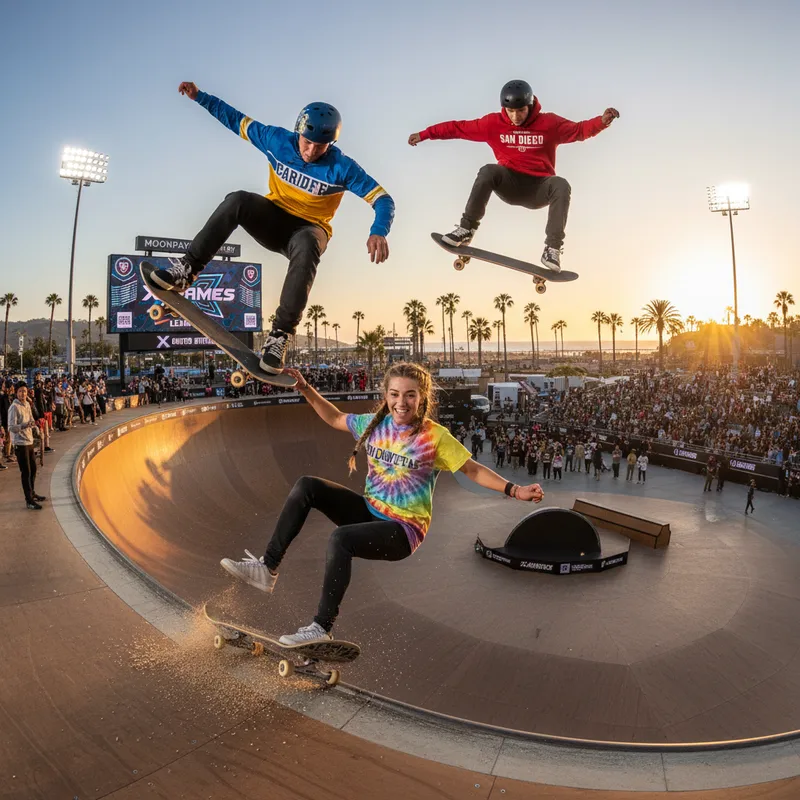
Three of San Diego County’s own have been drafted into the inaugural season of the MoonPay X Games League (XGL), a new team-based format for the premier action sports competition. Skateboarders Tom Schaar of Cardiff, Bryce Wettstein of Encinitas, and Tate Carew of San Diego were among the 40 top-tier athletes selected for the league’s first-ever draft last month.
The new league marks a significant evolution for the X Games, shifting from a purely individual competition to a co-ed, team-oriented championship season. Schaar, a decorated veteran of the sport, was selected No. 2 overall by X Games Club Los Angeles. Wettstein and Carew were both drafted by X Games Club New York. The league also includes franchises in Tokyo and São Paulo, with each club rostering five men and five women.
The draft, held on March 12 at Cosm in Los Angeles, kicks off a new chapter for athletes accustomed to competing for personal glory. Now, their individual performances will contribute to a collective team score, with a significant prize at the end of the line.
A new era for the X Games
While the format introduces a team dynamic, the core of the competition remains familiar to the athletes. The league spans the traditional X Games summer events, with points awarded based on individual placements in contests like Big Air, Vert, and Park. The team with the most cumulative points after the final event will be crowned the league champion.
It’s still just the X Games, so not much has really changed in the way they’re going to run it. same contests, same format, same people. But while the X Games are happening, the league points come into play. Most winners will be on teams, and points are awarded based on placement. At the end, the team with the most points across the three X Games events will be crowned champion. There’s also a $500,000 bonus for the winning team, which is a pretty sick incentive.” The 2026 summer season begins June 26 in Sacramento, followed by a stop in Japan in July, and will conclude with the championship event at the Caesars Superdome in New Orleans. Similar events in sports have seen major financial milestones, such as when the Toronto Tempo signed its first $1M backcourt star. The league boasts a total prize and salary purse of nearly $10 million for its 40 athletes. A winter version of the league is already planned for its debut in 2027.
For the athletes, it’s a venture into uncharted territory. "It’s still really new to us. I’m just excited to be a part of it. I really don’t know what to expect," Schaar says. "It’ll be cool getting to have a crossover of sports, working together, and then trying to win the championship would be pretty sweet, too. I think it’s really cool. We’re going to try and expand to maybe a new audience. they can understand if it’s team-oriented a little more, maybe.”
Skateboarding's spiritual home
The inclusion of three local athletes in the league’s inaugural draft is no surprise. San Diego has long been considered the heartland of skate culture, a reputation Schaar emphatically endorses. “Everyone just ends up here for skating,” he says, calling the area “the mecca” of the sport.

The region’s deep roots in skateboarding trace back to the 1950s, when California surfers sought ways to ride waves on land when the ocean was flat. By 1964, San Diego surfboard makers Larry Gordon and Floyd Smith of Gordon & Smith Surfboards revolutionized the nascent sport by creating the Fibreflex, the first laminated skateboard deck, giving riders more control and durability.
Throughout the 1970s, as urethane wheels made for a smoother and faster ride, San Diego’s unique landscape shaped the sport’s progression. An empty Escondido Reservoir and a delayed housing tract in La Costa became legendary, albeit temporary, skate spots. These locations, with their concrete banks and winding roads, influenced the design of the purpose-built skate parks that would follow. In 1975, the Del Mar National Championships brought a new, aggressive style of skating to the forefront, popularised by the Zephyr team from Los Angeles, also known as the Z-boys.
Just one year later, in May 1976, the Carlsbad Skatepark opened as one of the first two public skate parks in the world, cementing the county’s status as a global hub. Today, with more than 35 skate parks across the county, the culture is more vibrant than ever.
A legacy of legends
Part of what makes San Diego a skateboarding powerhouse is the concentration of talent, past and present. Schaar notes that legends like Bucky Lasek and Bob Burnquist are local residents. “They always say when you grow up, don’t meet your heroes. But in skating, I think it’s the opposite. Everyone’s really cool, and they’ve always been really nice to me,” he says.
Perhaps no figure looms larger in the sport than Tony Hawk, the Carlsbad-born icon who resides in Encinitas. Schaar, who lives just five minutes from Hawk, counts him as a friend and mentor. “Tony’s great. He’s always looked out for me and given me opportunities I wouldn’t have had otherwise,” Schaar says. “He’s always been a fan of skating in general, looking out for the next generation. I think he’s one of the best ambassadors for any sport.”
Hawk’s own legendary career includes 12 consecutive world championships with the National Skateboard Association and landing the first-ever 900-degree spin in competition. His influence extends to other action sports stars like snowboarder and skateboarder Shaun White, whom Hawk met and began mentoring at a San Diego skate park when White was just nine.
For aspiring skaters, Schaar recommends Poods Skatepark in Encinitas and the Washington Street Skate Park. “You could go to [Encinitas] any day of the week, and you’ll see someone doing some ridiculous stuff,” he says. For a more grassroots experience, he points to the DIY park under the freeway near Old Town. “Washington Street. that one’s pretty cool. It’s like a DIY park built 20-something years ago, and people have been keeping it alive.”
The future of action sports
Despite the camaraderie, skateboarding remains a physically punishing sport. Schaar, who started skating at age four, has endured a shattered shoulder, a broken wrist, and a broken toe. “I had a few bad injuries as a kid, and those definitely stuck with me,” he says. “There are tricks I tried when I was eight that I’m still scared to do now because I got hurt attempting them, but eventually you have to get over stuff like that.”
The launch of the X Games League comes at a time of significant growth for professional sports in Southern California. It joins the SoCal Women’s Pro Flag Football League, also debuting in 2026, and a new professional fencing league partnered with UC San Diego. The increased investment and interest in niche sports also comes as the region prepares to host the 2028 Summer Olympics in Los Angeles, where skateboarding has become a marquee event.
With its first season on the horizon, the XGL represents a bold step forward, blending individual skill with team strategy. For athletes like Schaar, Wettstein, and Carew, it’s a chance to make history and perhaps redefine what it means to be a professional skateboarder. As the league prepares for its June debut, the entire action sports world will be watching to see how this new-look X Games unfolds. For now, the athletes are embracing the journey into the unknown.