Overview & Character
Little Italy is one of San Diego's most vibrant and culturally rich urban neighborhoods, offering a unique blend of old-world European charm and modern, cosmopolitan living.
Originally a hub for Italian fishermen and their families in the 1920s, the neighborhood has evolved into a bustling, stylish district celebrated for its exceptional culinary scene, lively atmosphere, and strong community spirit.
The character of Little Italy is defined by its pedestrian-friendly streets, historic buildings repurposed into chic boutiques and galleries, and gleaming new mid-rise and high-rise residential towers.
It attracts a mix of young professionals, couples, and food connoisseurs who are drawn to the energetic, walkable lifestyle and the constant buzz of activity, from the weekly farmers' market to its numerous festivals.
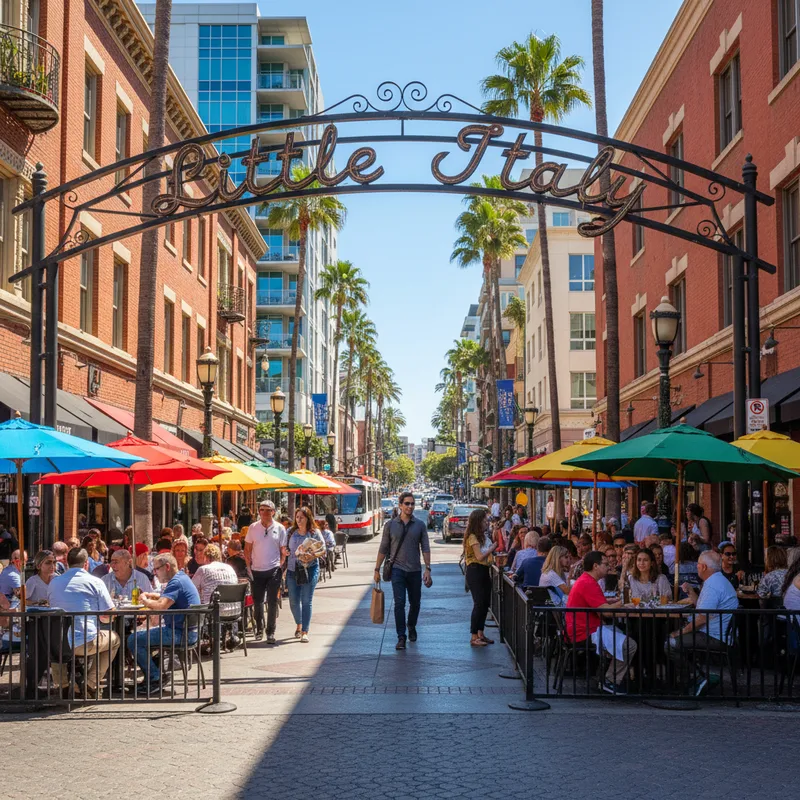
The vibe is undeniably social and energetic. On any given day, the sidewalks of India Street—the neighborhood's main artery—are filled with people dining al fresco, sipping coffee at bustling cafes, or browsing the unique local shops.
Despite its evolution and growth, the neighborhood has fiercely protected its Italian heritage, which is proudly displayed through the large "Little Italy" sign arching over India Street, the Italian-inspired piazzas (public squares), and the annual festivals that celebrate Italian culture.
This fusion of history and contemporary style creates a dynamic and inviting atmosphere that feels both authentically historic and refreshingly modern.
Location & Geography
Perfectly positioned in Downtown San Diego, Little Italy offers unparalleled access to the city's best amenities. The neighborhood is situated just north of the Core-Columbia district and west of Cortez Hill.
Its boundaries are generally considered to be Laurel Street to the north, Front Street to the east, Ash Street to the south, and the San Diego Bay and Pacific Highway to the west.
This prime location places it within walking distance of the Embarcadero and Waterfront Park, offering stunning views of the bay.
The topography of Little Italy is relatively flat, making it extremely easy to navigate on foot or by bicycle. It covers a compact area of approximately 0.48 square kilometers, contributing to its dense, urban feel.
Its proximity to the coast provides a pleasant coastal climate and refreshing sea breezes.
The neighborhood's location means residents are just minutes away from the San Diego International Airport, the Santa Fe Depot train station, and the Port of San Diego's cruise ship terminal.
Demographics & Population
Based on recent census data, Little Italy is a densely populated and dynamic urban neighborhood. The population is approximately 1,656 residents, though some city estimates place it closer to 5,000 when accounting for recent residential growth.
The population density is significant, reflecting its urban character and prevalence of multi-unit housing.
The median age in Little Italy is 37, with a large proportion of residents (around 52.4%) falling between the ages of 25 and 44. This demographic points to a community dominated by working professionals, singles, and couples without children.
The ethnic makeup is predominantly White (approximately 76.8%), with other groups including Hispanic (13.4%), Asian (5.4%), and African American (2.3%). Around 78.6% of residents are US-born citizens.
The median household income is approximately $91,566, which is reflective of the professional nature of its residents and the higher cost of living in the area.
Property Market
The real estate market in Little Italy is one of the most robust and expensive in San Diego. The housing stock consists almost exclusively of modern condominiums, lofts, and apartments, housed in mid-rise and high-rise buildings. There are very few single-family homes in the neighborhood.
The median real estate price in Little Italy is approximately $1,078,567, making it more expensive than over 90% of neighborhoods in the United States. This high value reflects the area's desirability, prime location, and premium amenities.
The rental market is equally competitive, with the average rental price around $4,660 per month, significantly higher than the California average.
The strong demand for both sales and rentals makes Little Italy a prime area for property investment, though the high entry cost is a significant factor.
Education
As a dense urban neighborhood primarily populated by adults without children, there are no public schools located directly within Little Italy's small boundaries. However, the community is served by the broader San Diego Unified School District.
Families with children residing in Little Italy have access to nearby schools in adjacent neighborhoods, including Washington Elementary School.
For higher education, the neighborhood's central location provides convenient access to several downtown campuses, including the NewSchool of Architecture and Design and California Western School of Law.
The University of California San Diego's extended studies and urban planning departments also have a presence nearby.
Transport & Getting Around
Little Italy is one of San Diego's most well-connected and walkable neighborhoods. With a very high walkability score, most daily errands can be accomplished on foot. The neighborhood’s grid layout and flat terrain make it ideal for pedestrians.
Public transportation is excellent. The San Diego Trolley's Green Line serves the neighborhood with a station at County Center/Little Italy, providing direct access to Old Town, Mission Valley, and East County.
Several bus routes also run along the neighborhood's main thoroughfares. For those commuting by car, the I-5 freeway is easily accessible.
The San Diego International Airport is conveniently located just a five-minute drive away, making it exceptionally convenient for frequent travelers. Proximity to the Santa Fe Depot provides access to Amtrak and COASTER commuter rail services.
Parks, Recreation & Lifestyle
The lifestyle in Little Italy is active, social, and centered around its vibrant street life. While the neighborhood is densely developed, it offers charming public spaces for recreation and relaxation.
Amici Park is a key community feature, offering a dog park, a bocce ball court, and an amphitheater for events.
The Piazza della Famiglia, a 10,000-square-foot European-style plaza on India Street, serves as the community's heart, hosting live music and gatherings.
Nearby, the San Diego Waterfront Park provides expansive green space, interactive fountains for children, and stunning bay views, all within a short walk.
The lifestyle is heavily influenced by the culinary scene, with residents and visitors alike flocking to the area for its world-class dining.
As one local puts it, the best pastime is to "hang out at the Piazza... on Friday evenings and listen to live music while watching the sunset over the water."
Shopping & Dining
Little Italy is arguably San Diego's premier dining destination. India Street and Kettner Boulevard are lined with an incredible density of restaurants, from traditional Italian "trattorias" to high-end, chef-driven concepts.
Notable establishments include the historic Filippi’s Pizza Grotto, the modern seafood restaurant Ironside Fish & Oyster, and the upscale Kettner Exchange, known for its rooftop cocktails.
The Little Italy Food Hall offers a variety of casual gourmet options in a communal setting.
Beyond dining, the neighborhood boasts a charming and eclectic retail scene. Residents enjoy browsing the many independent boutiques, art galleries, and specialty shops like Nibble Chocolate and Earth Elements.
The famous Little Italy Mercato Farmers’ Market is a major weekly draw every Saturday, stretching for several blocks and offering fresh local produce, artisanal foods, flowers, and crafts.
It's considered one of the best farmers' markets in the nation.
History & Heritage
Little Italy's history dates back to the early 20th century when it became home to a thriving community of Italian immigrants, primarily involved in Southern California's flourishing tuna fishing industry.
For decades, it was the heart of the Italian-American community in San Diego, a tight-knit neighborhood of families who built the beautiful Our Lady of the Rosary Catholic Church in 1925, which still stands as a cultural and spiritual anchor.
The decline of the tuna industry and the construction of the I-5 freeway in the mid-20th century physically divided the neighborhood, leading to a period of decline.
However, beginning in the 1990s, the community-led Little Italy Association spearheaded a remarkable revitalization.
Through focused investment in public spaces, cultural preservation, and business development, the neighborhood transformed into the prosperous and vibrant district it is today, all while honoring its rich Italian heritage.
Community & Events
A strong sense of community is a cornerstone of life in Little Italy. The neighborhood is brought together by numerous annual events that celebrate its Italian culture and lively spirit.
The most famous is the Little Italy Festa, a massive street festival held every October featuring traditional food, music, and art.
Other popular events include the Taste of Little Italy, the Summer Film Festival, and the festive Little Italy Tree Lighting and Christmas Village.
The weekly Mercato Farmers' Market is more than just a place to shop; it's a social gathering point for residents. The Piazza della Famiglia and Amici Park also host frequent community gatherings, from live music performances to cultural celebrations.
Our Lady of the Rosary Catholic Church remains an active center for the community, particularly for families with long-standing ties to the neighborhood.
Safety & Services
As a bustling downtown neighborhood and popular tourist destination, Little Italy experiences crime levels consistent with a dense urban environment. Property crime is more common than violent crime.
The area is well-patrolled by the San Diego Police Department, and the presence of numerous businesses and high foot traffic, particularly in the evenings, contributes to a general feeling of safety on the main commercial streets.
Prospective residents an check official crime statistics from the SDPD for detailed information. The neighborhood is served by the San Diego Fire-Rescue Department, with stations located nearby in the downtown area.
Several world-class hospitals, including UC San Diego Health, are located just a few miles away.
Development & Future
Little Italy has undergone significant development over the past two decades, with numerous mid-rise and high-rise mixed-use projects adding thousands of residential units and new retail spaces.
This trend is expected to continue, with a focus on infill development and increasing residential density.
The Little Italy Association maintains a strong influence on the planning process, advocating for projects that enhance the neighborhood's walkability, public spaces, and architectural character.
The focus for the future is on maintaining the unique balance of a historic cultural neighborhood with the demands of a modern, growing city.
Living in Little Italy, San Diego: Pros & Cons
Pros:
- Unmatched Walkability: Residents can easily walk to restaurants, cafes, shops, the farmers' market, and the waterfront.
- World-Class Dining Scene: It is a food lover's paradise with some of the best restaurants in San Diego right at your doorstep.
- Vibrant Atmosphere: There is always something happening, from community events and festivals to a bustling nightlife.
- Central Location: Superb access to the airport, freeways, public transit, and the rest of downtown.
- Strong Community: The neighborhood has a very active community association that hosts regular events and maintains the area's charm.
Cons:
- High Cost of Living: Real estate and rental prices are among the highest in San Diego.
- Noise Levels: The constant buzz from restaurants, bars, and events can be a drawback for those seeking tranquility.
- Lack of Green Space: While it has charming piazzas, the neighborhood itself lacks large, traditional parks.
- Parking Challenges: Street parking is difficult to find, and dedicated parking can be expensive.
- High Density: The area is very dense with a lot of foot and vehicle traffic, which may not appeal to everyone.