
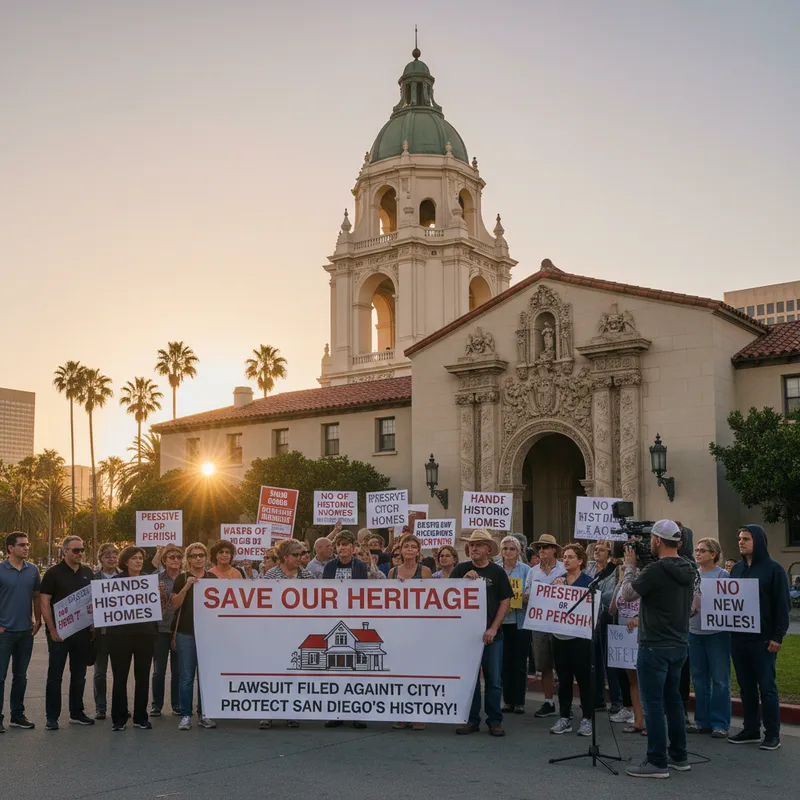
San Diego’s leading historic preservation group has launched a legal challenge against the city, seeking to halt new rules that critics say will weaken protections for heritage properties. The Save Our Heritage Organisation (SOHO) filed a writ of mandamus this week, arguing the city unlawfully approved the policy changes without conducting a proper environmental review.
The lawsuit targets a package of amendments the San Diego City Council approved on Feb. 24. A key provision of the new rules grants the council the authority to overrule decisions made by the city’s Historical Resources Board, the expert body responsible for designating properties as historic. Another change allows developers in Ocean Beach to use the city’s Complete Communities housing incentive program for projects, provided they do not demolish a historic cottage.
SOHO contends that the city violated the California Environmental Quality Act (CEQA) by failing to produce a new, comprehensive environmental impact report (EIR) specifically for these changes. Instead, the city relied on previous environmental analyses from other projects, a move SOHO’s legal filing argues is improper and fails to account for the unique impacts of altering preservation standards.
Legal challenge centres on environmental review
At the heart of SOHO's lawsuit is the argument that the city is improperly "piecemealing" a larger set of reforms collectively known as "Preservation and Progress." The changes approved in February represent only the first of a two-part initiative. City officials are expected to consider a second, more far-reaching package of updates later this year.
According to SOHO’s 11-page filing, CEQA’s "whole of the action" provision requires that all components of a single project be studied together to fully assess their combined environmental impact. The group argues the city is attempting to circumvent this rule by splitting the controversial proposal into smaller pieces, thereby minimizing the perceived environmental and cultural effects of the overall plan.
SOHO is asking a judge to compel the city not only to rescind the recently approved changes but also to analyze them alongside the forthcoming second package in a single, comprehensive EIR. The group points out that the changes were opposed by the Community Planners Committee, an umbrella organization representing the city’s neighbourhood planning groups, which voted unanimously against the measures.

Historic places are an integral part of our environment and shared city identity.
Housing needs clash with heritage protection
City officials and developers have defended the new rules as modest and necessary reforms. They argue the changes are crucial for streamlining development and supporting the city’s broader pro-housing agenda, which aims to address San Diego’s severe housing shortage. From their perspective, the previous regulations were overly cumbersome and sometimes obstructed the creation of new homes under initiatives like Complete Communities, which encourages density near transit corridors.
The City Attorney’s office declined to comment on the lawsuit, citing a policy of not discussing pending litigation. However, the approved changes are part of a larger, ongoing debate in many California cities: how to balance the urgent need for new housing with the desire to protect the architectural and cultural heritage that defines a community’s character.
This tension is expected to intensify when the city introduces the second half of the 'Preservation and Progress' initiative. Those proposed changes could include limiting the Mills Act, a state program providing significant property tax breaks to owners who agree to preserve and maintain their historic homes. Another potential change is the elimination of the automatic historical review trigger for buildings once they reach 45 years of age. Such a move would remove a critical checkpoint that has led to the identification and protection of many of San Diego's modern and mid-century architectural gems.
Future of preservation standards uncertain
The lawsuit creates uncertainty for both developers and preservation advocates. Should a judge side with SOHO, the city would be forced back to the drawing board, potentially delaying projects and forcing a public re-evaluation of its approach to housing and history. The court could mandate a new EIR covering all proposed changes, from the council’s veto power to the potential adjustments to the Mills Act, forcing a more holistic and transparent review process.
Proponents of the changes argue that delays will only exacerbate the housing crisis, while preservationists maintain that once a historic resource is lost, it is gone forever. They argue that a thorough environmental review, as required by state law, is essential for making informed decisions about the future of San Diego’s landscape.
The legal action ensures that the debate over how San Diego grows will continue to be a central issue. The outcome will have lasting implications for the city’s neighbourhoods, its housing supply, and the preservation of its cultural identity. The city has posted details on the approved and proposed changes on its "Preservation and Progress" webpage, available at sandiego.gov/preservationandprogress.