
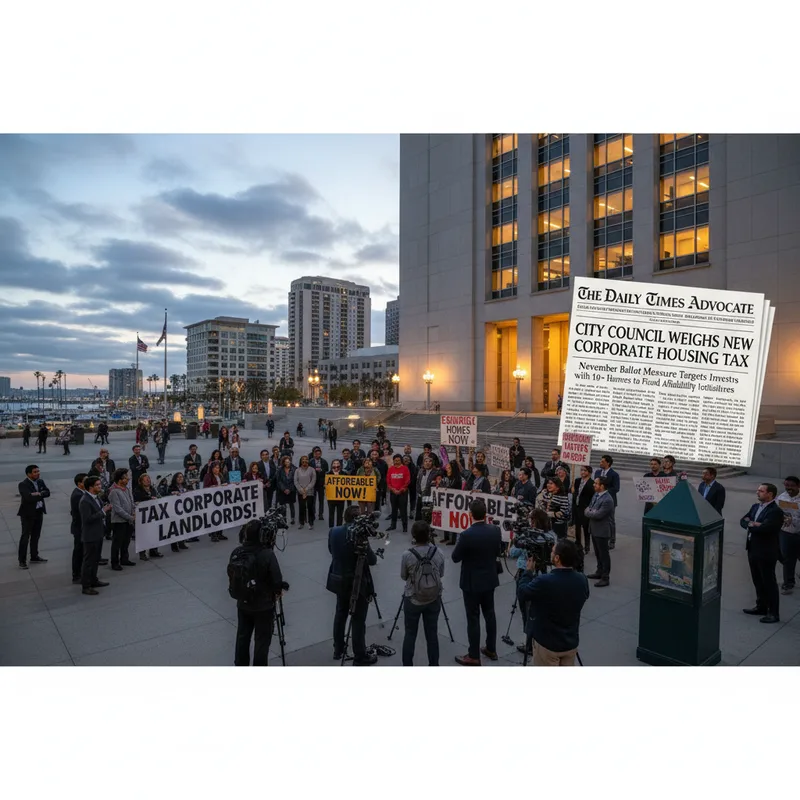
San Diego is considering a novel approach to tackle its housing affordability crisis, with city council members endorsing a potential ballot measure aimed at taxing corporate investors who purchase single-family homes in bulk.
The proposal, spearheaded by Councilmember Kent Lee, would levy a new tax on companies that own and rent out more than 10 single-family homes or other small residential properties like duplexes and condominiums. The goal is to discourage large-scale investment strategies that convert entry-level homes into rental properties, thereby freeing up more housing stock for ordinary San Diegans to purchase.
On Wednesday, the council’s Rules Committee voted 5-0 to advance the proposal, signalling strong initial support. The measure could appear on the November ballot for voters to decide.
A cautious and calculated approach
While the problem of corporate ownership is considered less severe in San Diego than in other major American cities, an initial review found that approximately 6,000 of the city’s 500,000 homes are owned by corporate entities. Proponents argue this is a significant enough portion of the market to impact aspiring homeowners.
The large portfolio ownership of single-family homes is commercializing the American dream,” said Councilmember Kent Lee. “These types of owners are taking the promise of homeownership and turning it into a profit-making mechanism.
The local initiative reflects a growing sentiment seen at both state and federal levels. California Governor Gavin Newsom has called for similar legislation, and the U.S. Congress recently passed the bipartisan 21st Century Road to Housing Act to restrict institutional investors from buying up homes. The high cost of housing in the region remains a persistent challenge for residents, as documented by real estate market data from sources like Zillow. Similar issues have surfaced in Miami, where the skyline is transforming with a wave of 'supertall' towers.
Despite the support, council members and industry groups are proceeding with caution. Lee has emphasized his desire for a transparent and collaborative process to avoid unintended consequences, such as discouraging new home construction or having landlords pass the tax costs on to tenants.
Stefanie Benvenuto of the Building Industry Association urged city officials to ensure the tax is narrowly focused. “We want to make sure we are not slipping into a situation where we are taxing rental homes,” she said, adding it was critical not to slow investment or hinder a separate initiative from Mayor Todd Gloria to encourage more townhome construction.
Council President Joe LaCava praised Lee’s measured strategy. “I think we can all reach agreement pretty easily on what the problems are, but it’s very difficult for government to be surgical in its approach and really get the intended consequences to solve a problem,” LaCava said.
Part of a wider housing strategy
To address these concerns, Lee confirmed the tax would likely be progressive, increasing with the number of homes an entity owns, and would specifically exempt newly built housing. The focus remains on the types of properties that have historically served as the first step onto the property ladder for families.
The proposal has drawn strong backing from other council members, including Sean Elo-Rivera, who framed the issue as a matter of principle. “Housing is a human right, and that means corporate and speculative investment that makes housing more difficult to access is wrong,” Elo-Rivera stated. He identified large firms like Blackstone and Greystar as prime examples, accusing them of neglecting properties and using algorithms to maximize rental profits.
This investor tax is not the only measure the city is exploring. Elo-Rivera has also been championing a separate, but related, ballot measure to tax vacant homes. That proposal would impose an annual tax starting at $8,000 on homes left unoccupied for more than 182 days a year. The tax could rise to $15,000 for properties owned by corporations. After initially failing to gain traction when it included short-term vacation rentals, the revised proposal focusing only on empty second homes cleared a committee hurdle in February.
Together, the two proposals represent a multi-pronged strategy to address San Diego’s housing shortage. While Lee’s measure targets the conversion of for-sale housing into long-term corporate rentals, Elo-Rivera’s initiative aims to push empty investment properties back onto the for-sale or long-term rental market, tackling a problem estimated to affect over 5,000 properties in the city. Other municipal issues, such as Calgary battling its own illegal dumping problem, show how cities are increasingly looking for novel solutions to civic challenges.
What happens next
For the corporate ownership tax to reach voters, it will need final approval from the full City Council. Because the generated revenue would go into the city's general fund rather than being earmarked for a specific purpose, the measure would only require a simple majority at the ballot box to pass. This is a significantly lower threshold than the two-thirds majority required for special-purpose taxes.
However, the path forward is not set in stone. Lee acknowledged that the complexity of the issue might require more negotiation and analysis, potentially pushing the vote to a later election to ensure the policy is crafted correctly. In the meantime, some related ideas, such as giving tenants a first right of refusal when a property is sold, could be implemented through city ordinances rather than a public vote.
The move comes as the city simultaneously manages other major financial and civic files, including a proposed budget that involves cuts to some services like the road safety team and the potential record-breaking sale of the San Diego Padres.
“We’re still early in the process, and we’ll be looking forward to engaging stakeholders and the public,” Lee said, signalling that a robust debate is expected in the months ahead.