

The San Diego-Chula Vista-Carlsbad region has climbed to become the seventh-smoggiest metropolitan area in the United States, according to the latest "State of the Air" report from the American Lung Association. The region worsened its position from last year, when it was ranked eighth for high ozone days.
The annual report, released Tuesday, paints a troubling picture of air quality nationwide, finding that nearly half of all American children live in communities with unhealthy levels of air pollution. The findings suggest that decades of progress made under the Clean Air Act are now in jeopardy.
Wimmer noted that recent policy decisions have exacerbated the problem. "In the last year, EPA has weakened enforcement and rolled back rules that would have protected kids from power plant and vehicle pollution," he says. "Children need clean air to grow and play, and communities need clean air to thrive. Leaders at every level must act to improve and protect America's air quality."
California cities dominate smog rankings
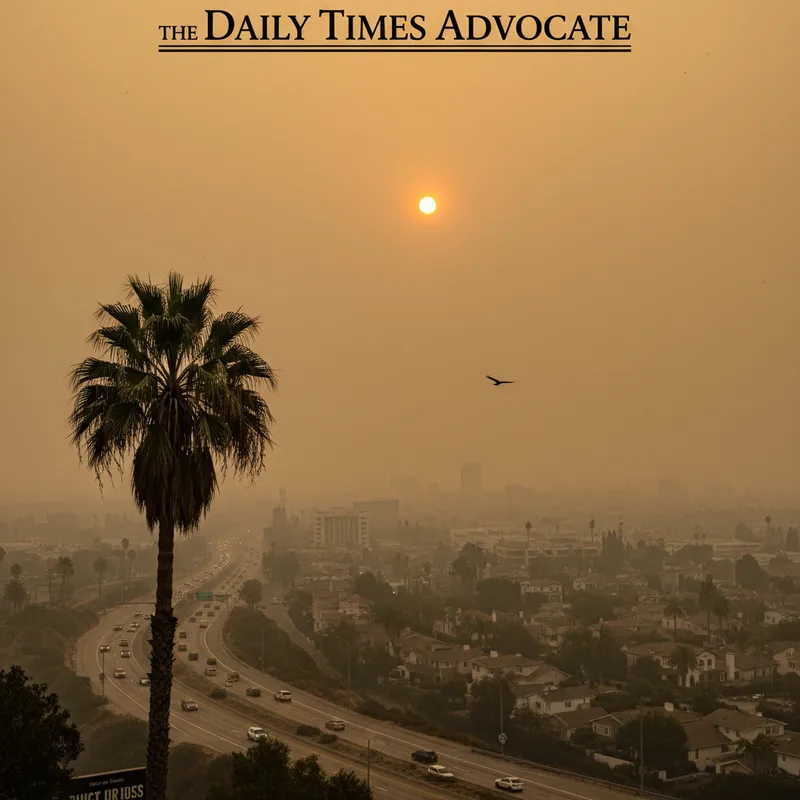
California metropolitan areas featured prominently at the top of the list for ozone pollution. The Los Angeles-Long Beach area once again held the top spot as the nation's smoggiest region, a position it has held for 26 of the last 27 years. Three other California communities, Visalia, Bakersfield-Delano, and Fresno-Hanford-Corcoran, also placed in the top five, interrupted only by Phoenix-Mesa, Arizona, at number four.
Clean air is not something we can take for granted. It takes work. For decades, people in the U.S. have breathed cleaner air thanks to the Clean Air Act. Unfortunately, that progress is now at risk due to extreme heat and wildfires, fueled by climate change, and policy changes that are making the problem worse.
Ground-level ozone, the primary component of smog, is not emitted directly into the air. It is created by chemical reactions between oxides of nitrogen (NOx) and volatile organic compounds (VOCs) in the presence of sunlight. Major sources of NOx and VOCs include vehicle emissions, industrial facilities, and power plants. The American Lung Association describes the effect of inhaling ozone as being "likened to a sunburn of the lungs," which can cause coughing, shortness of breath, trigger asthma attacks, and even lead to premature death.
The report also highlighted significant racial disparities in exposure to air pollution. People of colour are more than twice as likely as white people to live in a county that received a failing grade for all three pollution measures studied. For Hispanic people, that likelihood is more than three times greater.
Particle pollution and local efforts
While ozone remains a primary concern, the report also measured particle pollution, or soot. San Diego County ranked as the fifth-most polluted region in the country for year-round particle pollution, which is an annual average of fine particulate matter. However, the area was not among the top 25 most-polluted for short-term particle pollution, which measures daily spikes often caused by events like wildfires. For comparison, Kern County was ranked the most polluted county in the nation for year-round particle pollution.
Local efforts are underway to address some of the underlying causes of air pollution. In a move that promotes the use of clean energy, San Diego Gas & Electric (SDG&E) has expanded its "Super Off-Peak" electricity rates to weekdays between 10 a.m. and 2 p.m. year-round. This window is when solar energy production is at its peak, and encouraging electricity consumption during these hours can reduce reliance on fossil-fuel power plants, especially during hot afternoons when demand is high.
"This concept is a win-win for grid stability, a win-win for renewables, and a win-win for our customers," said Anthony Wagner, a spokesperson for SDG&E. The utility estimates customers could save around 20 per cent on electricity costs by shifting the use of major appliances to these hours. The change also benefits customers of San Diego Community Power and the Clean Energy Alliance.
This initiative aligns with broader goals to improve air quality, as transitioning to renewable energy sources is a key strategy in reducing the precursor pollutants that form ground-level ozone. It also helps with grid stability as California works to integrate more renewable energy. More information on local environmental initiatives can be found at the San Diego County Department of Environmental Health website.
Health implications and future outlook
The health consequences of poor air quality are significant and affect the entire population, but especially children, older adults, and individuals with pre-existing respiratory conditions like asthma. Both ozone and particle pollution can cause and worsen health problems, leading to increased hospitalizations and emergency room visits. The city's investment in transportation infrastructure, such as road safety, can also play a role, as traffic congestion is a major contributor to vehicle emissions. Unfortunately, Boston mayor's budget cuts funding for dozens of street safety projects, a move that could have indirect consequences for traffic flow and emissions.
The American Lung Association's report serves as a stark reminder that air quality is not a guarantee. While California has long been a leader in environmental regulation, the combination of climate change-driven heatwaves, wildfires, and shifting federal policies presents a formidable challenge. The report's authors emphasize that continued vigilance and stronger standards are necessary to protect public health.
As Wimmer stated, the fight for clean air requires concerted effort at every level. From individual choices, like shifting energy use, to systemic policy changes, addressing the region's air quality crisis will be a critical task for residents and leaders in the years to come.