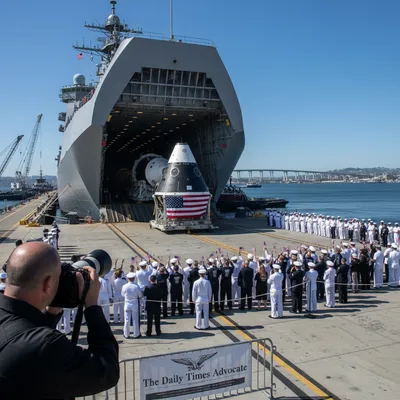
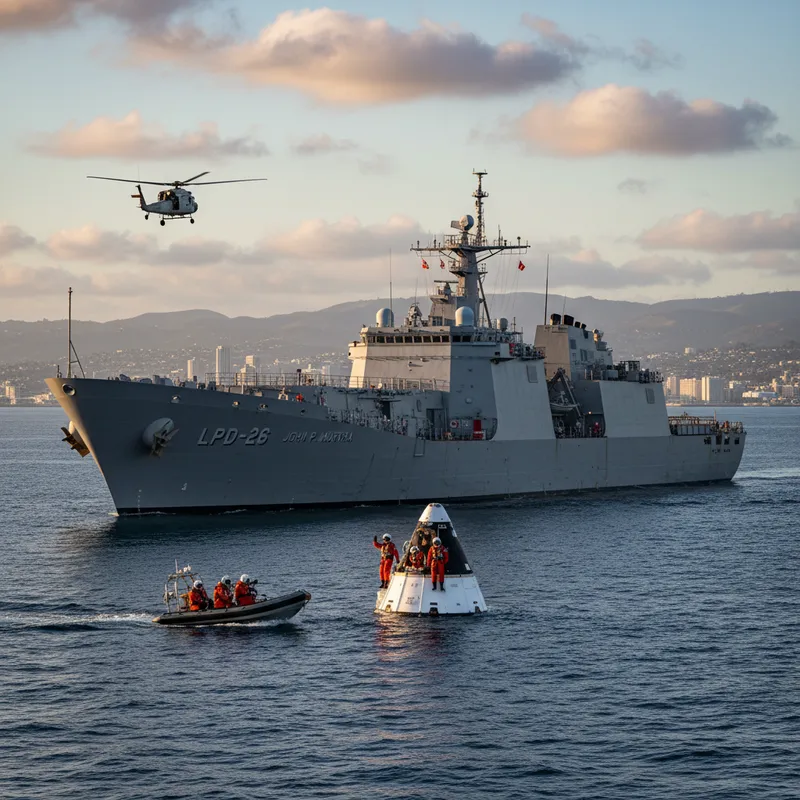
A San Diego-based naval vessel has been tasked with the crucial role of recovering the four astronauts of the Artemis II mission following their historic flight around the moon. The U.S. Navy confirmed Monday that the amphibious transport dock ship USS John P. Murtha (LPD 26) will retrieve the crew and their Orion space capsule after it splashes down in the Pacific Ocean this Friday.
The 684-foot warship departed Naval Base San Diego on Monday to position itself for the meticulously planned operation. The Orion capsule is scheduled to re-enter Earth’s atmosphere and land in the ocean at approximately 5:07 p.m. PDT, at a location roughly 50 to 60 miles off the coast of Southern California. The successful recovery is the final critical step in NASA’s first crewed mission of the Artemis program.
The Artemis II flight marks a significant milestone in human space exploration, sending astronauts on a trajectory around the moon for the first time in over 50 years. This mission serves as a vital test of the Orion spacecraft’s life-support systems and capabilities before future missions attempt to land humans on the lunar surface.
A new chapter in space exploration
The Artemis program, named after the twin sister of Apollo in Greek mythology, aims to establish a sustainable human presence on the moon and prepare for future missions to Mars. While Artemis I was an uncrewed test flight that successfully orbited the moon, Artemis II is the first to carry a human crew, paving the way for the planned Artemis III mission, which will see astronauts walk on the moon once again.
The recovery of the crew and capsule is not just about bringing the astronauts home safely, it is also about retrieving invaluable data from the flight. The Orion spacecraft itself will be carefully hoisted from the ocean and brought back to land for extensive analysis. This examination is crucial for engineers at NASA to understand how the vehicle performed during its journey through deep space, its fiery re-entry, and its splashdown. More information on the mission is available on NASA's official Artemis program website.
For the crew aboard the USS John P. Murtha, this mission represents a unique deviation from their typical duties of transporting and deploying U.S. Marines and their equipment. The ship and its crew underwent extensive, specialized training to prepare for this complex recovery operation, working alongside NASA engineers to perfect the procedure. This included exercises using a full-scale test version of the Orion capsule to simulate the recovery process in the ship’s well deck.
The mechanics of a Pacific splashdown
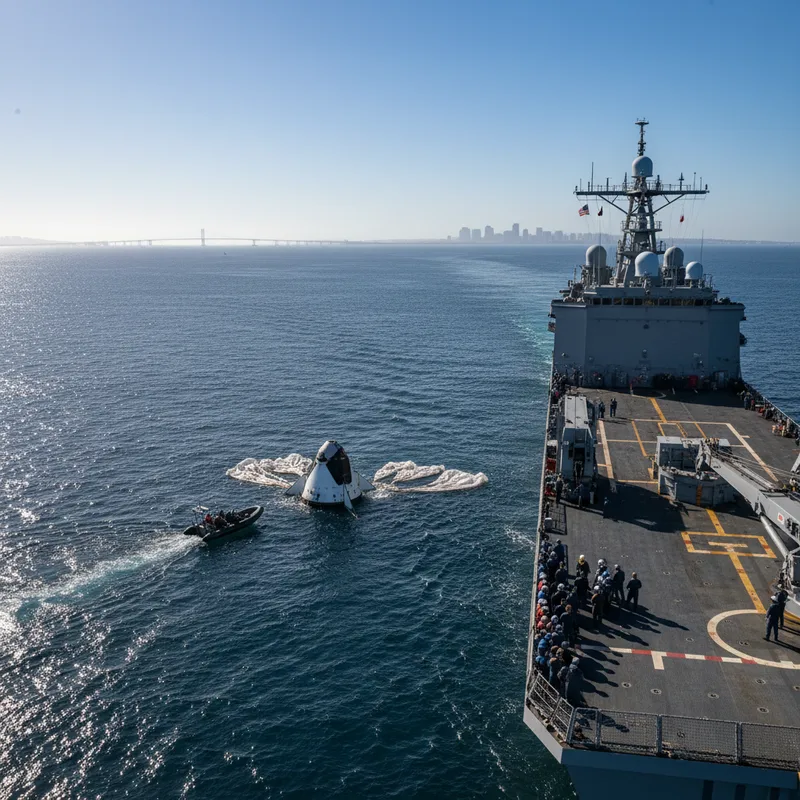
The dramatic conclusion to the Artemis II mission will begin with the Orion capsule streaking through the upper atmosphere. A sequence of 11 parachutes will deploy to slow the craft from its hypersonic re-entry speed to a gentle landing in the ocean. Skies are expected to be overcast at the time of the splashdown.
Immediately after hitting the water, five bright orange airbags will inflate on the capsule’s exterior. These bags are designed to keep the spacecraft upright in the water, ensuring the crew remains safe and making the recovery process more manageable for the naval team. Small boats from the Murtha will then approach the capsule, with divers and recovery specialists working to safely extract the four astronauts.
Once the crew is safely aboard the USS John P. Murtha, the complex task of recovering the multi-billion-dollar Orion spacecraft begins. The ship's well deck, which can be flooded with sea water, allows the capsule to be carefully guided inside the hull of the ship and secured for transport. NASA and the U.S. Coast Guard have issued warnings for the public and private boaters to maintain a safe distance from the landing area. The re-entry process is expected to shed pieces of debris that will fall into the sea, creating a potential hazard for any vessels that venture too close.
The operation continues a long tradition of the U.S. Navy assisting NASA with astronaut recovery, a partnership that dates back to the earliest days of the Mercury program in the 1960s.
San Diego’s enduring naval legacy
The selection of the USS John P. Murtha highlights San Diego’s integral and ongoing role in U.S. naval operations and, by extension, national and international endeavours like the Artemis program. As a key base for the U.S. Pacific Fleet, San Diego is home to a vast array of naval assets and personnel. The Murtha is part of the U.S. 3rd Fleet, whose area of operations spans the vast Indo-Pacific region.
The city has a storied maritime history, having been the home port for many famous vessels, including the decorated Second World War light cruiser USS San Diego (CL-53). While the city is a hub of military power, it also offers a wide range of civilian attractions, from world-class museums to abundant free activities for residents and visitors, and some of the best hikes near Tacoma are just a short drive away.
Once the astronauts are safely on board the Murtha, they will receive a medical check-up. They will then be transported by helicopter to Naval Air Station North Island in Coronado. From there, the crew will board a jet and be flown to Houston, Texas, the home of NASA's astronaut corps, where they are expected to hold a news conference to discuss their historic journey.
The successful completion of their mission and their safe return will be celebrated around the world, marking another major step in humanity’s journey back to the moon and beyond. The mission’s success hinges on this final, critical recovery phase, carried out by the skilled personnel of San Diego's own USS John P. Murtha.