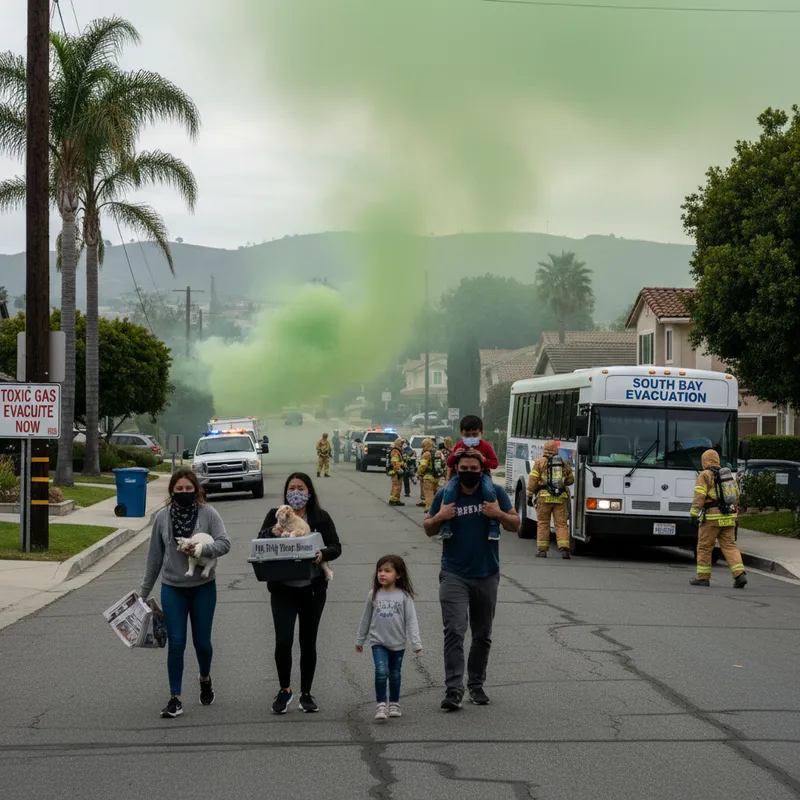
A long-simmering sewage crisis in San Diego’s South Bay is boiling over, with toxic gas forcing some residents from their homes as officials warn the region is entering a new era of environmental disaster. New data reveals that hydrogen sulfide gas, smelling of rotten eggs, is spewing from the polluted Tijuana River at dangerously high levels, creating what one expert calls “an air quality crisis with no parallel anywhere else in the United States.”
Researchers from UC San Diego’s Airborne Institute recorded hydrogen sulfide levels reaching as high as 4,500 parts per billion (ppb) recently, a staggering figure that is 150 times the state’s safety standard of 30 ppb. On one recent Sunday, levels surpassed 2,000 ppb, a concentration higher than what is typically found inside wastewater treatment plants themselves.
'An air quality crisis with no parallel'
For residents like Sonia Mayorga of Imperial Beach, the situation has become a personal health emergency. She and her husband have been forced to leave their home after suffering from persistent headaches, nausea, and throat irritation. “We have a beautiful home, with my family over there, we can’t go back because it’s so toxic,” Mayorga said in an interview. “Our bodies can’t handle it, so we have to be out.”
Crisis reaches a breaking point
The alarming spike in toxic gas mirrors conditions last seen in September 2024, but local officials say the problem is now reaching a breaking point. “It’s a milestone nobody wants,” said San Diego County Supervisor Paloma Aguirre, who represents and lives in Imperial Beach. “We’re entering a new era of crisis.”
Aguirre noted that the duration of exposure is also increasing, with recent data showing hydrogen sulfide levels remaining above the state limit overnight for the first time on April 5. “Despite me having my air purifiers cranking and my windows shut, that’s just to say nobody should be living in these conditions,” Aguirre stated, adding that headaches are a daily occurrence for her when she is at home.
I’ve never had so many people in the community essentially begging for help. It’s really, really, a very sad and troubling situation that has to end.

Dr. Kimberly Prather, a distinguished professor at UC San Diego's Scripps Institution of Oceanography and the Airborne Institute, has been at the forefront of monitoring the crisis. She highlighted the severity of the recent readings, noting that levels this high typically require specialized protective equipment for workers. “These levels are levels that workers in wastewater treatment plants put on all their PPE and walk around, right? The community doesn’t have that,” Prather said. She has since urged Gov. Gavin Newsom in an open letter to declare a state of emergency. Prather also warned that hydrogen sulfide is just one of thousands of harmful gases detected in the area.
Decades of neglect and a search for solutions
The root of the problem lies south of the border in Mexico's crumbling sewage infrastructure, which allows vast amounts of raw sewage and industrial waste to flow untreated into the Tijuana River. The river then carries this toxic cocktail across the border into San Diego, polluting the Tijuana River Valley and estuary, and forcing frequent closures of popular shorelines, including some of San Diego's best beaches. In a separate but related issue, Council to debate 'extreme risk' of northern beaches erosion highlights similar environmental concerns, though in a different region. The current crisis is exacerbated by stagnant water in the river valley, which allows pathogens to fester and release dangerous gases.
While some federal funding has been allocated to repair and expand a wastewater treatment plant on the U.S. side of the border, Supervisor Aguirre says there is currently no comprehensive plan to address the source of the issue: the broken wastewater management system in Mexico. Hundreds of thousands of people on both sides of the border are exposed to the hazardous gases.
In response to the escalating health risks, California State Sen. Steve Padilla has introduced legislation aimed at strengthening public health protections. The bill, SB 58, would compel the state's Office of Environmental Health Hazard Assessment to establish a new, more stringent public health standard for hydrogen sulfide based on current science. It would also grant local air pollution districts more authority to protect the public. “We don’t have a standard that reflects the current science,” Padilla told a state senate committee.
An uncertain future for residents
This legislative push comes amid a scientific debate over what constitutes a safe level of exposure. While California’s standard is 30 ppb, the U.S. Environmental Protection Agency (EPA) has suggested that prolonged exposure to just 1.4 ppb could cause illness. However, there is no official federal standard, a regulatory gap influenced by the oil and gas industry in the 1990s, according to a report from Voice of San Diego. This leaves residents in a precarious position, living in an area that has unfortunately become a real-world laboratory for the health effects of long-term toxic gas exposure.
The fight for a solution has drawn pledges of action from various political candidates, but for residents like Mayorga, relief cannot come soon enough. Her emotional plea highlights the human cost of the environmental catastrophe. “I literally wanna cry. I wanna go back and I can’t,” she said. The ongoing health challenges in the region are now compounded by this severe air quality threat.
Despite the dire situation, community leaders like Supervisor Aguirre remain committed to their homes. When asked why she stays, she replied emotionally, “Because I love IB.” Her dedication underscores the deep ties residents have to their community, even as it faces an unprecedented threat. The path forward involves navigating a complex web of international diplomacy, securing massive federal investment, and overhauling public health regulations, with the health of thousands of San Diegans hanging in the balance.