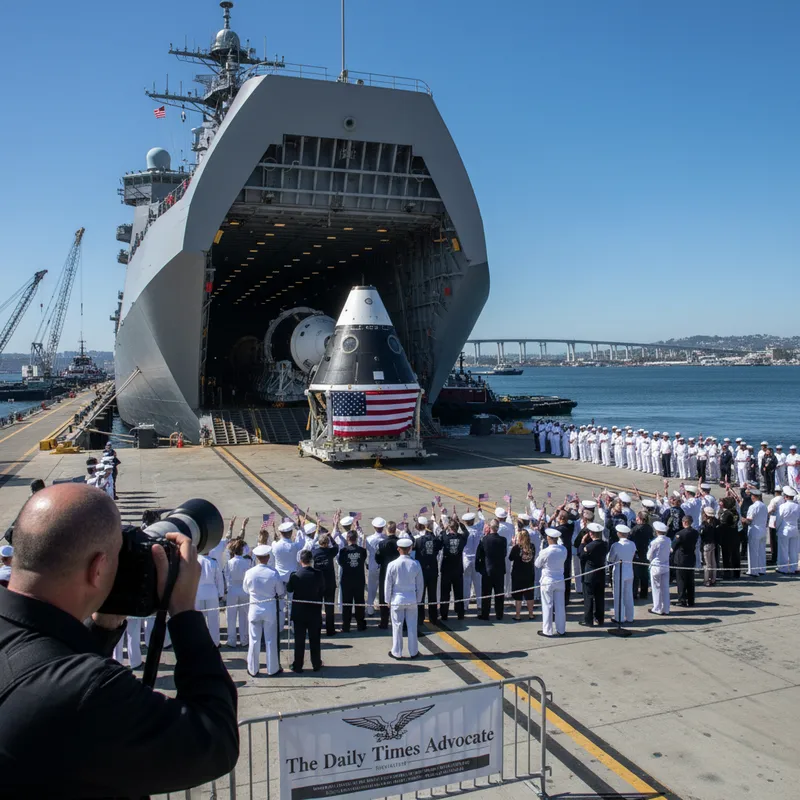
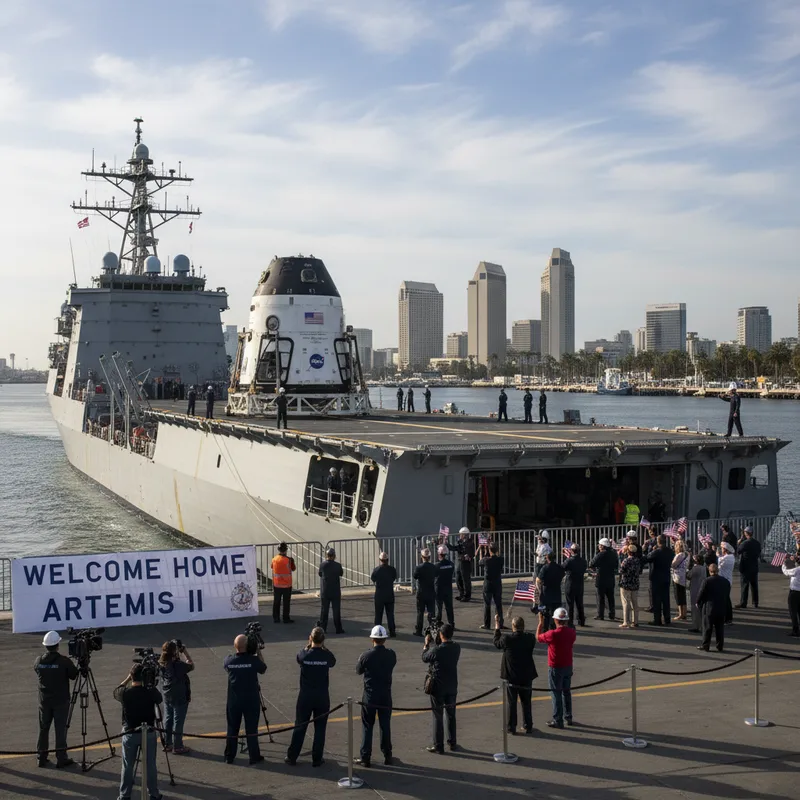
A naval warship returned to San Diego on Saturday morning not as an instrument of conflict, but as a symbol of human exploration, delivering the Artemis II mission’s Orion capsule to a waiting crowd. The USS John P. Murtha, an amphibious transport dock ship longer than two football fields, arrived at Naval Base San Diego with Elton John’s “Rocket Man” playing over its speakers, a nod to the public fascination with the first crewed lunar mission in over 50 years.
The 10-day mission, which saw four astronauts circle the moon, captivated a global audience. It marked the first time since December 1972, with the return of Apollo 17, that American astronauts have concluded a mission with a splashdown in the ocean. The Artemis II return drew significantly more public interest than its predecessor, which occurred amid national divisions over the Vietnam War.
The successful mission comes as a point of national pride and a unifying moment. Governor Gavin Newsom praised the Golden State’s crucial role, highlighting the contributions of thousands of workers and hundreds of companies. “The crew splashing down off the California coast is a full-circle moment and point of immense pride,” Newsom stated. “Artemis II is a unifying moment for all of us here on Earth that we can shoot for the stars and strive for a brighter future, for all.”
A complex recovery at sea
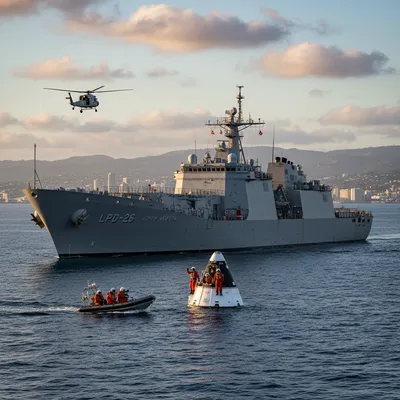
The day before its triumphant arrival in port, the Murtha played a critical role in the complex recovery of the Orion capsule and its crew approximately 50 miles west of San Diego. On Friday, astronauts Reid Wiseman, Victor Glover, Christina Koch, and Canadian Space Agency astronaut Jeremy Hansen splashed down in the Pacific Ocean at 5:07 p.m., the exact moment forecasted by NASA. Despite the picture-perfect landing, the recovery effort faced several challenges. Navy and NASA teams contended with unexpectedly strong ocean currents, making it difficult for divers to secure the capsule. While spectators who had gathered along the coast at spots like Sunset Cliffs were disappointed by the lack of a sonic boom upon re-entry, the online broadcast showed the recovery unfolding in real time. Similar issues have surfaced in disaster recovery, where FEMA offers disaster aid for storm recovery.
An initial communication glitch between the recovery boats and the astronauts inside the capsule was quickly resolved. However, the surging currents made it harder for crews to deploy a flotation collar around the spacecraft and inflate a raft known as the “front porch.” This platform was essential for the astronauts to exit the capsule before being hoisted 40 feet up to hovering helicopters.
Navy officials explained that hoisting the crew by helicopter was a safer and more reliable option than attempting a boat transfer, as the calmness of the sea could not be guaranteed. Capt. Erik Kenny, the Murtha’s commanding officer, followed the action on an iPad displaying live NASA video while skilfully manoeuvring the massive ship to create favourable conditions for the multiple helicopter landings on the vessel's deck as sunset approached.
Reflections from the crew
Once aboard the Murtha, the astronauts were greeted by cheers from the ship’s crew, who captured the historic moment on their phones, a modern parallel to the Kodak Instamatic cameras used during the Apollo era. After medical exams in the ship’s hospital, the crew was flown to Houston.
Their return to Texas on Saturday was poignant, coinciding with the 56th anniversary of the launch of Apollo 13, a mission that turned a near-catastrophe into a legendary tale of survival. The Artemis II astronauts shared their emotional reflections on the monumental journey.
When you look up here, you’re not looking at us. We are a mirror reflecting you. And if you like what you see, then just look a little deeper. This is you.
Commander Reid Wiseman spoke of the profound experience of leaving and returning to our planet. “This was not easy,” an emotional Wiseman said. “Before you launch, it feels like it’s the greatest dream on Earth. And when you’re out there, you just want to get back to your families and your friends. It’s a special thing to be a human, and it’s a special thing to be on planet Earth.”
Pilot Victor Glover added, “I have not processed what we just did and I’m afraid to start even trying.”
A legacy of service and exploration
The USS John P. Murtha (LPD 26) and its crew spent significant time preparing for the mission, working closely with NASA engineers. The San Diego-based ship is named for the late Pennsylvania Congressman John P. Murtha, a decorated Marine Corps veteran and passionate advocate for the military.
“It is a fitting tribute to Congressman Murtha, who dedicated his life to serving our nation, that the ship bearing his name will be integral to this historic moment in space exploration,” said Capt. Kenny. “We are honored to carry on his legacy by supporting NASA and the Artemis II mission.” Previous missions, like the recent recovery of the Artemis I capsule, helped prepare the joint Navy and NASA teams for this crewed flight.
The Orion capsule will now be offloaded at the naval base and transported for extensive post-flight analysis by NASA engineers. The successful mission represents a major step forward for the Artemis program, which aims to establish a sustainable presence on the moon and eventually support future missions to Mars. For San Diego, the ship’s return is a proud moment, reinforcing the region's deep-rooted connection to both national defence and the frontiers of space exploration.