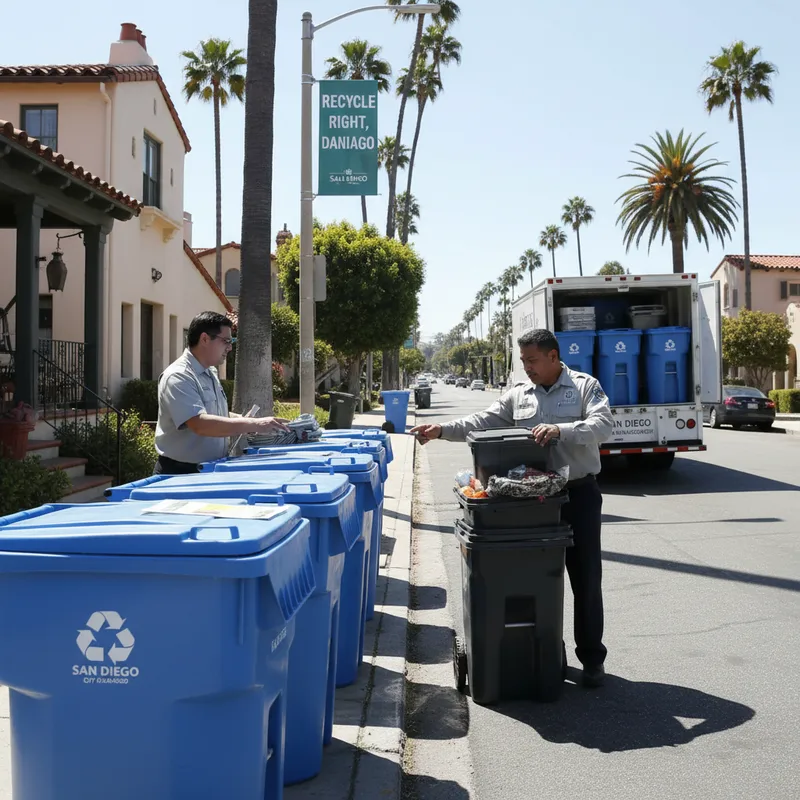
The City of San Diego is moving forward on two major fronts in its overhaul of municipal waste collection, beginning the citywide delivery of new light blue recycling bins while issuing final warning notices to approximately 850 property owners who have not transitioned to private haulers.
The changes are the latest steps in a complex and often contentious shift away from a century-old system of free trash collection for some residents to a universal fee-based service. The moves come just weeks after a local business group announced a planned ballot measure aiming to temporarily repeal the new fees, adding another layer of uncertainty to the city’s long-term waste management strategy.
Starting this week, residents will see new, lighter blue recycling bins arriving in their neighbourhoods. The rollout will proceed sequentially by collection route through the early fall. The city is replacing the old, dark blue bins as part of a system-wide upgrade that officials say will improve service and accountability.
A costly and controversial upgrade
The decision to purchase the new bins was a controversial one, with the city council approving a $41.5 million contract for 750,000 new grey and light blue containers last year. An additional $23.2 million was allocated for the delivery of the new bins and the removal and recycling of 950,000 old ones. Critics questioned the expense and the environmental impact of replacing containers that were, in many cases, only a few years old.
However, city officials have defended the expenditure, arguing the new bins are essential for the modernized, fee-based system. The new containers are equipped with tracking chips to monitor service and prevent loss, and their uniform appearance is intended to help collection crews work more efficiently. Each new bin also includes a dedicated slot for residents to write their address, a simple feature aimed at preventing the common neighbourhood problem of mixed-up bins.
The delivery of the blue recycling bins follows the near-completion of the grey trash bin distribution. Since that process began last October, the city reports it has delivered over 231,000 new grey bins, making the program 96 per cent complete.
The city has assured residents that the old containers will be recycled. Contractor Rehrig Pacific Co. will process the old bins into plastic regrind, which can be used to manufacture new containers, pallets, or other industrial products.
Crackdown on service holdouts
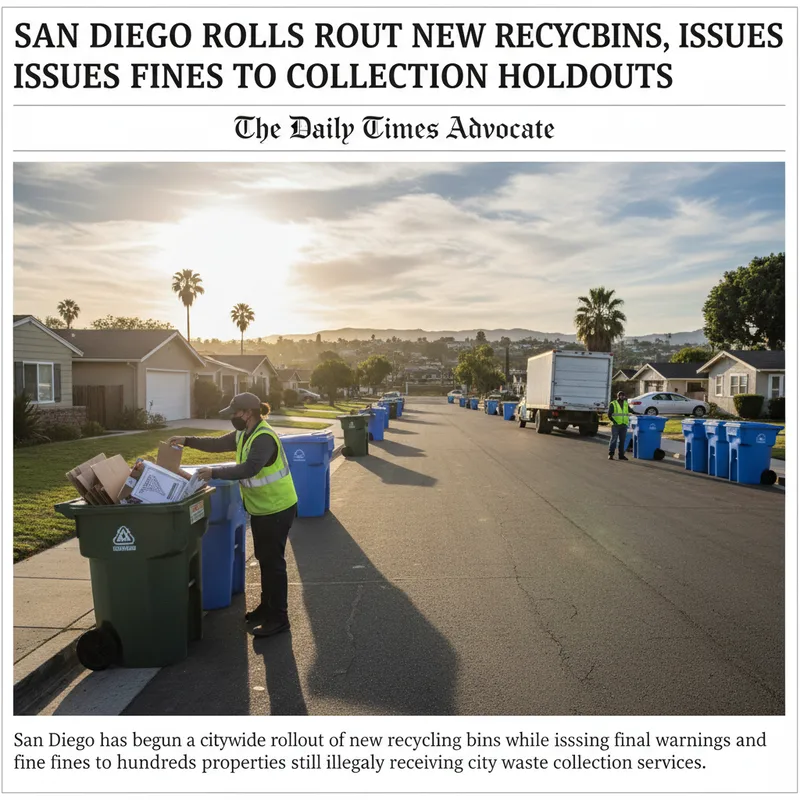
While the bin swap moves forward, the city is also taking a harder line on properties that were deemed ineligible for city collection but have refused to hire private waste services. An analysis determined that 17,246 properties, mostly multi-family residential buildings, were improperly receiving city service. While the city says over 95 per cent of those have since complied, about 850 "holdouts" remain.
Those properties are now receiving final warning notices, with the city planning to impose escalating fines for non-compliance. The penalties begin at $200 every two weeks, rising incrementally to a maximum of $1,000 for each two-week period of violation.
They’re deadbeats, and they need to pay. It’s about compliance, they need to comply with the law.
Jim Madaffer, executive director of the San Diego County Disposal Association, which represents private haulers, minced no words on the matter. "They’re deadbeats, and they need to pay," Madaffer said. "It’s about compliance, they need to comply with the law." He noted that both the city and private haulers have worked to help these properties find new service at a reasonable cost, including by softening certain recycling rules to make collection more feasible for multi-family complexes.
For months, the city has avoided cutting off service due to potential health and safety concerns. However, that phase appears to be ending. City spokesperson Kelly Terry stated by email that after rounds of fines, the Environmental Services Department "may proceed to remove city containers for those customers."
A new era of trash fees
The entire transition stems from the 2022 passage of Measure B, which dismantled the "People's Ordinance" of 1919. For more than a century, that ordinance had provided free trash pickup exclusively to single-family homes, leaving residents of apartments and condos to pay for private services. Measure B’s passage by voters allowed the city to begin charging all residents for trash and recycling, ushering in the current system and its monthly fee of $43.60 for full service.
The shift aims to create a more equitable system and provide a dedicated funding stream for waste services, which are under increasing pressure from state mandates like SB 1383 to expand recycling and organic waste diversion. More information on state recycling requirements can be found at the CalRecycle website.
But the new fees have drawn the ire of the Lincoln Club Business League, a pro-business group that is now sponsoring a ballot initiative to suspend the fees from July 2027 through June 2029. Because the measure seeks to repeal a fee, it requires a much lower number of signatures to qualify for the November ballot, just over 21,000. This makes its appearance before voters highly likely.
If passed, the measure would blow a significant hole in the city's budget, reducing revenue by nearly $100 million annually and jeopardizing future service improvements. The city’s financial planning often involves complex negotiations, such as those surrounding the terms of the Petco Park sale, and the sudden loss of a major revenue stream would create significant challenges. By contrast, some other municipalities are expanding free services, as seen in how Brampton offers free summer transit passes for youth.
The potential repeal directly impacts the current recycling bin rollout. The city plans to use the new bins and the fee revenue to increase blue bin collection from every other week to once a week starting on July 1, 2027. If the ballot measure succeeds and the fees are suspended on that exact date, that planned service enhancement may not happen.